Off-grid touring is becoming one of the biggest lifestyle shifts in caravanning and motorhoming. More owners want the freedom to stay on quieter sites, use basic pitches, explore remote locations and rely less on electric hook-up.
Solar power can make that much easier.
A well-planned solar setup can help keep your leisure battery topped up, power everyday 12V equipment and give you more flexibility when touring. It will not turn your caravan or motorhome into a house on wheels, and it will not run everything indefinitely, but it can make off-grid trips more practical, comfortable and enjoyable.
This guide explains how off-grid power works, what solar panels can and cannot do, how to think about battery capacity, and which accessories are worth considering before your next trip.
What does off-grid touring mean?
Off-grid touring means using your caravan, campervan or motorhome without being connected to mains electric hook-up.
That could mean:
- Staying on a basic pitch without electric
- Attending rallies or temporary holiday sites
- Using a certificated location with limited facilities
- Stopping overnight in a motorhome where permitted
- Spending a few days somewhere quieter and more remote
- Reducing your reliance on campsite facilities
For some people, off-grid touring means one night away without plugging in. For others, it means several days using solar, gas, leisure batteries and careful power management.
The important thing is to understand what your setup can realistically support.
Why are more people interested in off-grid caravan and motorhome touring?
Off-grid touring appeals to different owners for different reasons.
Some want more freedom. Others want to avoid busy campsites, reduce pitch costs or stay closer to nature. Motorhome owners may want more flexibility on touring routes, while caravan owners may want to make better use of simpler sites.
The appeal is easy to understand:
- More choice of places to stay
- Less reliance on electric hook-up
- Quieter touring experiences
- Better flexibility for short breaks
- Useful backup power when travelling
- Potential savings on some pitch fees
- More confidence on rallies and basic sites
Off-grid touring does require a little more planning, but the right accessories can make a big difference.
How does solar power work in a caravan or motorhome?
A caravan or motorhome solar setup usually includes:
- A solar panel
- A charge controller
- A leisure battery
- Wiring and fuses
- Optional monitoring equipment
- Optional inverter for selected mains-style appliances
The solar panel collects energy from daylight and sends it through a charge controller. The controller regulates the charge going into your leisure battery. You then use the stored energy from the battery to power suitable equipment in your caravan or motorhome.
The key point is that the solar panel is usually charging your battery rather than directly powering everything at once.
A solar panel can help maintain battery charge, but your battery is still the heart of the off-grid system.
What can caravan and motorhome solar panels power?
Solar panels are best for supporting low-power touring equipment, especially when paired with a healthy leisure battery.
They can help power or support:
- LED lighting
- Water pumps
- 12V televisions
- USB phone charging
- Tablet charging
- Fans
- Control panels
- Some WiFi or router equipment
- Fridge electronics, depending on the system
- Motor mover battery top-ups, depending on usage and charge level
Solar is not usually suitable for high-demand appliances such as:
- Electric kettles
- Toasters
- Hairdryers
- Electric heaters
- Microwaves
- Air fryers
- Domestic coffee machines
Those appliances draw far more power than a typical caravan or motorhome solar system is designed to provide. For off-grid touring, it is usually better to use gas for heating, cooking and hot water where your vehicle is designed for it.
Fixed solar panels vs portable solar panels
There are two main types of solar panel setup for caravans and motorhomes: fixed and portable.
Fixed solar panels
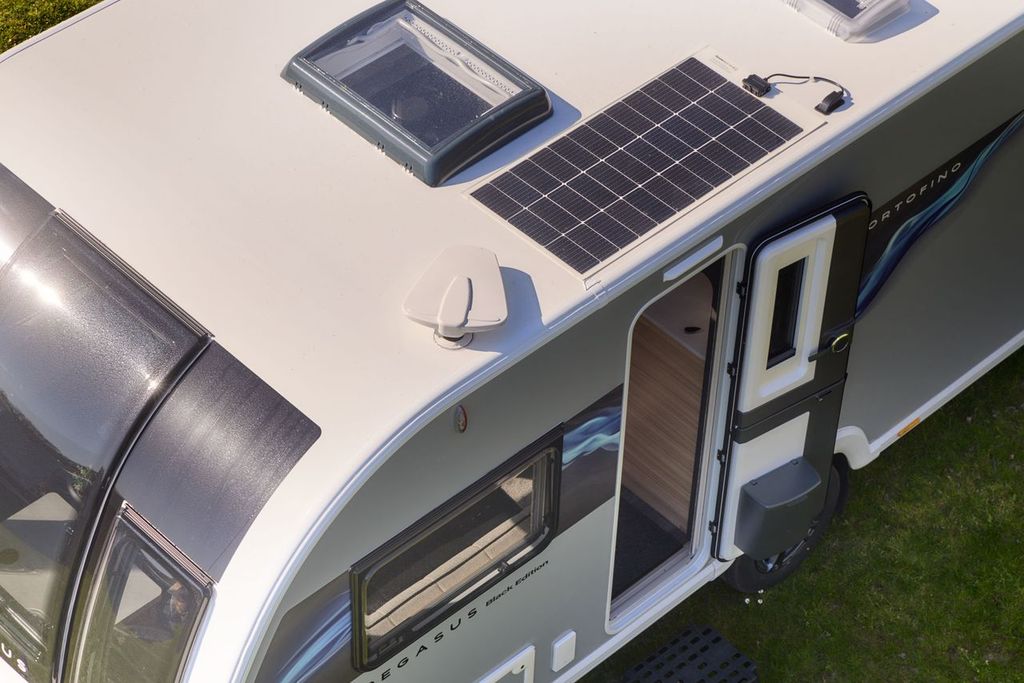
Fixed solar panels are permanently mounted to the roof of your caravan or motorhome.
They are convenient because they work whenever there is daylight, even while the vehicle is parked or stored outdoors. You do not need to set them up each time you arrive on site.
Fixed panels are ideal if you:
- Tour regularly
- Want a low-effort setup
- Use off-grid pitches often
- Want battery support while the vehicle is stored
- Prefer a tidy, permanent installation
The main downside is that the panel sits wherever the roof is facing. If your caravan or motorhome is parked in shade, performance will drop.
Portable solar panels
Portable solar panels, sometimes called suitcase solar panels, can be moved around and positioned towards the sun.
They are useful if you:
- Only go off-grid occasionally
- Park in shade but can place the panel in sunlight
- Do not want a permanent roof installation
- Want flexibility between different vehicles
- Are testing whether solar suits your touring style
The downside is that portable panels need setting up, packing away and storing securely. You also need to think about cable routes and security when using them on site.
Which solar panel size do you need?
The right solar panel size depends on how much power you use, how long you stay off-grid and what time of year you tour.
As a rough guide:
- 50W to 80W may help maintain a battery for very light use.
- 100W to 150W can suit short off-grid stays with sensible power use.
- 150W to 200W is a popular range for more regular off-grid touring.
- 200W+ may suit heavier users, larger motorhomes or owners who spend more time away from hook-up.
A weekend tourer who mainly uses LED lights, a water pump and phone charging will need far less than someone running a 12V TV, router, multiple devices and longer stays away.
Solar performance also changes with the weather and season. Summer daylight gives you far more usable charge than a grey winter weekend.
Why your leisure battery matters
Solar panels are only part of the system. Your leisure battery stores the energy you rely on when the sun is not producing enough power.
If your battery is old, undersized or poorly maintained, even a good solar panel will not perform at its best.
Common leisure battery types include:
- Lead-acid
- AGM
- Gel
- Lithium
Lead-acid and AGM batteries are common and often more affordable. Lithium batteries are more expensive upfront, but they are lighter, often allow more usable capacity and can suit owners who tour off-grid more frequently.
Before upgrading to lithium, it is important to check compatibility with your charger, solar controller and electrical system. Not every older caravan or motorhome is ready for a simple battery swap without further checks.
How much battery capacity do you need?
Battery capacity is usually measured in amp-hours, often written as Ah.
A common caravan leisure battery might be around 100Ah, but the amount you can safely use depends on the battery type. With some traditional lead-acid batteries, you should avoid draining the battery too far, as repeated deep discharge can shorten its life.
The right capacity depends on your usage.
Think about:
- How many nights you want to stay off-grid
- Whether you use a TV
- How many devices you charge
- Whether you use 12V fans or routers
- How much lighting you need
- Whether you tour in summer or winter
- Whether you move location regularly
- How often you can recharge
For occasional overnight stays, a modest setup may be enough. For longer off-grid trips, battery capacity becomes just as important as panel size.
What is a solar charge controller?
A solar charge controller sits between your solar panel and leisure battery. Its job is to regulate the charging process and protect the battery.
There are two common types:
- PWM controllers
- MPPT controllers
PWM controllers are usually cheaper and can work for simpler setups.
MPPT controllers are generally more efficient and can make better use of available solar energy, especially in changing light conditions. For many modern caravan and motorhome solar installations, an MPPT controller is often the preferred choice.
The charge controller must be correctly matched to your solar panel, battery type and system size.
Do you need an inverter?
An inverter converts 12V battery power into 230V mains-style power, allowing you to run some household-style devices when you are not plugged into electric hook-up.
However, inverters need to be used carefully.
They can drain a leisure battery quickly, especially when powering high-wattage appliances. A small inverter may be useful for laptops or low-power devices, but it is not a magic replacement for campsite electric.
Before fitting or using an inverter, think about:
- What you actually need to power
- The wattage of each device
- Battery capacity
- Cable sizing
- Safety
- Whether a 12V alternative would be better
In many cases, using 12V chargers and low-power touring accessories is more efficient than relying on an inverter.
What else do you need for off-grid touring?
Solar is useful, but off-grid comfort depends on the whole setup.
Helpful off-grid accessories can include:
- Leisure battery
- Solar panel
- Charge controller
- Battery monitor
- Gas bottle
- Water carrier
- Waste container
- Levelling ramps
- LED lighting
- 12V chargers
- Power banks
- Low-wattage kettle alternatives
- Thermal screens
- Awnings
- Outdoor furniture
- Security locks
- Fresh water hose
- Portable toilet chemicals
- Camping table and chairs
Some accessories help with power. Others help you stay comfortable without relying on full campsite facilities.
You can explore more touring essentials through the Couplands accessories and awnings showroom here: Awnings & Accessories
Where do awnings fit into off-grid touring?
An awning may not generate power, but it can make off-grid touring much more comfortable.
When you are staying on a basic pitch or spending more time outdoors, an awning gives you extra covered space for:
- Cooking preparation
- Wet coats and boots
- Dog beds
- Outdoor furniture
- Extra storage
- Bikes or equipment
- Dining space
- Shade in summer
For off-grid trips, a lightweight porch awning or air awning can be especially useful because it gives you flexible space without making setup too complicated.
For help choosing the right awning, read: Caravan Awning Buying Guide: How to Choose the Right Awning
How long can you stay off-grid in a caravan or motorhome?
How long you can stay off-grid depends on four main things:
- Battery capacity
- Solar charging
- Gas supply
- Water and waste capacity
Power is only one part of the equation. You may have enough battery charge for several days, but still need to refill fresh water or empty waste.
A light user with solar, gas heating and careful water use may manage several days away from electric hook-up. A heavy power user may run low much sooner, especially in poor weather.
For most beginners, it is sensible to start with one or two nights off-grid before trying a longer trip. This helps you understand your real power use without putting too much pressure on the setup.
How to reduce power use off-grid
The easiest way to extend off-grid time is to use less power.
Simple steps include:
- Switch to LED lighting
- Charge phones during sunny parts of the day
- Use 12V chargers instead of an inverter where possible
- Turn off devices fully rather than leaving them on standby
- Use gas for heating, cooking and hot water
- Avoid high-wattage appliances
- Keep TV use sensible
- Use thermal blinds to reduce heating demand
- Monitor battery levels regularly
- Keep your leisure battery in good condition
Good habits can often make as much difference as extra equipment.
Is solar worth it for caravans?
Solar can be worth it if you regularly tour without electric hook-up, store your caravan away from mains power or want more confidence that your leisure battery will stay topped up.
Solar may be especially useful if you:
- Use rallies or basic sites
- Take frequent weekend breaks
- Store your caravan outdoors
- Want to reduce reliance on hook-up
- Use 12V equipment regularly
- Want more flexibility when choosing pitches
If you only ever stay on fully serviced pitches with electric hook-up, solar may be less essential. It can still help maintain battery health, but it may not be a priority upgrade.
Is solar worth it for motorhomes?
Solar is often a popular upgrade for motorhome owners because motorhomes are commonly used for touring routes, stopovers and more flexible travel.
Solar may suit motorhome owners who:
- Move between locations regularly
- Use off-grid stopovers
- Want to keep batteries topped up while parked
- Use onboard 12V equipment often
- Prefer not to rely on electric hook-up every night
- Travel during spring and summer
A roof-mounted solar panel can be particularly convenient on a motorhome because it works quietly in the background whenever daylight is available.
Can solar panels charge the starter battery?
Some systems can charge or maintain both the leisure battery and the starter battery, but this depends on the setup.
A basic solar installation may only charge the leisure battery. More advanced systems may include split charging, dual battery support or additional controllers.
If maintaining the starter battery is important to you, ask before choosing a system. This is especially useful for motorhomes that may sit unused for longer periods.
Should you fit solar yourself or use a professional?
Portable panels can often be used without major installation, provided they are suitable for your battery and charging setup.
Fixed roof-mounted solar panels are different. They involve wiring, mounting, sealing, fusing and connecting to the electrical system. Poor installation can cause leaks, charging issues or electrical faults.
Professional fitting is usually the safer option for fixed systems, especially if you are unsure about:
- Roof mounting
- Cable entry points
- Charge controller sizing
- Battery compatibility
- Fuses and wiring
- Existing electrical systems
- Warranty implications
A properly fitted system should be safe, tidy and matched to your caravan or motorhome.
How much does caravan or motorhome solar cost?
Costs vary depending on panel size, controller type, fitting, battery upgrades and whether the system is fixed or portable.
A simple portable panel setup will usually cost less than a professionally fitted roof-mounted system. A larger solar system with lithium battery upgrades, monitoring and inverter equipment will cost more.
When budgeting, consider the full setup, not just the panel.
You may need:
- Solar panel
- Charge controller
- Mounting kit
- Cable entry gland
- Wiring and fuses
- Battery monitor
- Battery upgrade
- Inverter, if required
- Professional fitting
It is better to buy the right system once than to start with something too small and need to replace it later.
Off-grid touring checklist
Before heading away without electric hook-up, check the following:
- Leisure battery fully charged
- Solar panel working
- Charge controller displaying correctly
- Gas bottle level checked
- Fresh water filled
- Waste container empty
- Phone and power banks charged
- 12V chargers packed
- Torch or lantern packed
- Fridge settings understood
- Heating and hot water tested
- Tyre pressures checked
- Security locks packed
- Campsite or stopover rules confirmed
If you are new to off-grid touring, choose a familiar site or short trip first. You will quickly learn what you use, what you do not need and what would make the next trip easier.
What to think about before upgrading your setup
Before investing in solar or battery upgrades, ask yourself:
- How often do I tour without hook-up?
- Do I usually travel in summer or winter?
- How many nights do I want to stay off-grid?
- What equipment do I actually use?
- Is my current leisure battery healthy?
- Do I want a fixed or portable solar panel?
- Would a battery monitor help me manage power better?
- Is my caravan or motorhome suitable for a larger setup?
- Would professional fitting be better?
The best off-grid setup is not always the biggest one. It is the one that matches how you actually tour.
More freedom, with the right setup
Off-grid and solar power can make caravanning and motorhoming feel more flexible. You can use quieter pitches, rely less on electric hook-up and feel more confident when touring away from full facilities.
The key is to be realistic. Solar panels are excellent for maintaining leisure batteries and supporting low-power equipment, but they are not designed to run every household appliance. Battery capacity, gas, water, waste and good touring habits all matter too.
At Couplands Caravans, our teams in Louth and Worksop can help you explore accessories, awnings and touring equipment to make your caravan or motorhome better suited to the way you travel.
Whether you are planning your first off-grid weekend or upgrading your current setup for longer trips, the right accessories can make every journey easier.
FAQs
Can you run a caravan off solar power?
Yes, solar power can help run low-power 12V equipment in a caravan by charging the leisure battery. It can support lighting, phone charging, water pumps and other small devices, but it is not usually suitable for high-demand appliances such as electric kettles, heaters or microwaves.
What size solar panel do I need for a caravan?
For light use, a 100W to 150W solar panel may be enough for short trips. For more regular off-grid touring, many owners consider 150W to 200W or more. The right size depends on your battery capacity, equipment use, season and how many nights you want to stay off-grid.
Is a 100W solar panel enough for a caravan?
A 100W solar panel can be enough for light off-grid use, especially in summer, if you mainly use LED lights, phone charging and a water pump. It may not be enough for heavier use or longer stays without electric hook-up.
Can a solar panel run a caravan fridge?
It depends on the fridge and setup. Many caravan fridges are designed to run on gas, 12V while towing, or 230V mains hook-up. Running a fridge from battery power alone can use a lot of energy, so check your specific fridge and electrical system before relying on solar.
Do motorhomes need solar panels?
Motorhomes do not always need solar panels, but solar can be very useful if you use stopovers, tour without hook-up or want to keep batteries topped up while parked. It is one of the most popular upgrades for flexible motorhome touring.
Is a fixed or portable solar panel better?
A fixed solar panel is more convenient because it works without setup. A portable solar panel gives more flexibility because you can move it into the sun. The best option depends on how often you tour, where you park and whether you want a permanent installation.
Do I need a leisure battery with solar panels?
Yes, in most caravan and motorhome setups, the solar panel charges the leisure battery and you use stored power from the battery. The battery is what provides power when sunlight is low or when the panel is not generating enough.
Can I fit a solar panel to an older caravan?
Often, yes, but the setup needs to be checked carefully. Older caravans may need additional wiring, a suitable charge controller or battery checks before fitting solar. Professional advice is recommended for fixed installations.
Will solar work in winter?
Solar panels can work in winter, but output is usually much lower because daylight hours are shorter and the sun is weaker. If you tour off-grid in winter, you may need more battery capacity, careful power use and backup charging options.
What accessories do I need for off-grid caravanning?
Useful off-grid accessories include a leisure battery, solar panel, charge controller, battery monitor, gas bottle, water carrier, waste container, 12V chargers, LED lighting, levelling ramps and an awning for extra covered space.