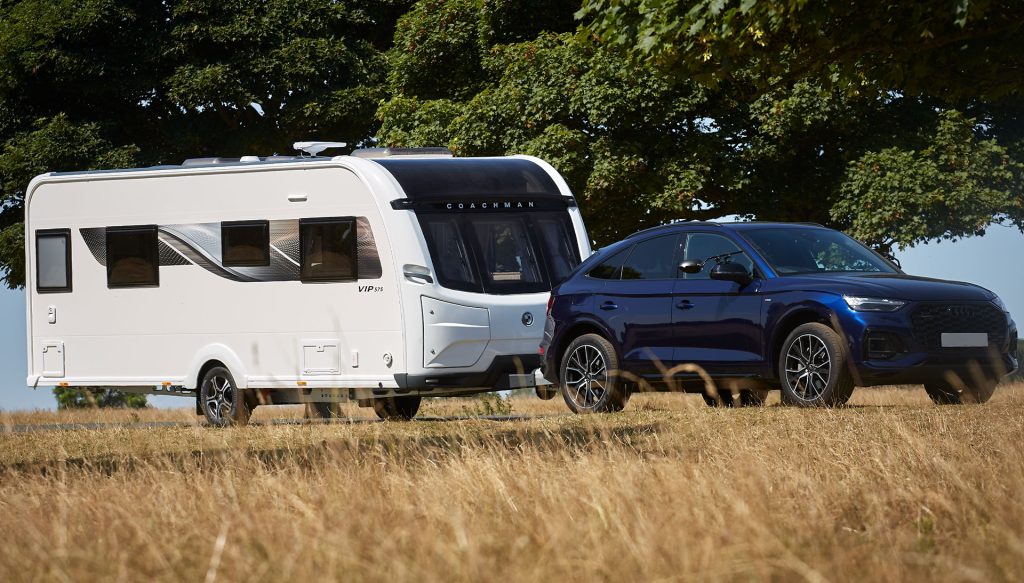
Learning how to reverse a caravan gets much easier once you understand one principle: when the car begins turning one way, the rear of the caravan initially moves in the opposite direction.
From there, the method is simple. Reverse very slowly, use small steering inputs and correct the angle before it becomes too sharp. Position your outfit carefully before starting, watch both towing mirrors, and never feel embarrassed about stopping and pulling forward.
This step-by-step guide covers the complete process, including how to reverse in a straight line, turn onto a pitch, work safely with a banksman and recover when the caravan starts heading the wrong way.
Before You Start Reversing
Do not begin the manoeuvre until you have inspected the space.
Stop somewhere safe, get out of the car and walk around the pitch or driveway. Check for:
- Low branches and overhanging signs
- Bollards, kerbs and drainage channels
- Electric hookup points
- Water taps and waste points
- Soft ground or steep slopes
- Children, pedestrians and pets
- Cars, awnings and neighbouring pitches
- Space for the front of your tow car to swing
That last point catches people out. As the caravan turns one way, the front of the car can swing a long way in the other direction.
Fit and adjust your towing mirrors before you begin. UK guidance requires drivers to have an adequate view behind the outfit and to fit suitable towing mirrors when the caravan is wider than the rear of the towing vehicle. If you need a set, or a better set, our accessories store stocks them at both branches.
Finally, turn off loud music, open the windows if that helps you hear your banksman, and ask passengers to stay quiet until the manoeuvre is complete.
Check Your Caravan’s Reversing Brakes
Caravan overrun brakes are designed to apply when the outfit slows, which creates an obvious problem in reverse.
Most modern caravans handle this automatically, so you simply reverse and the system takes care of itself. Some older caravans, however, use a reversing catch or lever on the coupling that has to be engaged before you reverse and released afterwards.
If the outfit feels like it is fighting you as soon as you select reverse, that is worth investigating rather than pushing through. Check your handbook, and if you are unsure which system your caravan uses, ask our workshop team — this comes up regularly on older used models.
How Caravan Steering Works in Reverse
Reversing a car on its own is intuitive: turn the wheel left and the rear of the car goes left. Adding a caravan reverses that first effect.
- Turn the steering wheel left and the rear of the caravan begins moving right.
- Turn the steering wheel right and the rear of the caravan begins moving left.
Once the caravan reaches the angle you want, you then steer the other way to follow it. Caravanners often call this “chasing” the caravan.
A useful beginner’s method is to place one hand at the bottom of the steering wheel, then move that hand towards the side where you want the back of the caravan to go:
- Move your hand left to send the caravan left.
- Move your hand right to send the caravan right.
This works because moving the bottom of the wheel left turns the steering wheel clockwise, which makes the car steer right and pushes the caravan left.
Whichever method you choose, stick with it. Switching between mental rules halfway through a manoeuvre creates confusion at exactly the wrong moment.
Step 1: Set Up the Outfit Properly
Good reversing starts before you select reverse gear.
Wherever possible, approach so the pitch sits on the driver’s side. This gives you a better direct view and usually makes the caravan easier to follow in the driver’s towing mirror.
Drive slightly beyond the entrance to the pitch, leaving enough space between the caravan and the pitch opening, and keep the outfit reasonably straight.
Avoid starting with the car and caravan already at a sharp angle. A poor starting position makes the whole manoeuvre harder and raises the risk of jack-knifing.
Stop, apply the brake and take one final look around before you reverse.
Step 2: Begin with a Small Steering Input
Select reverse and release the brake gently. Use the lowest practical speed, and avoid the accelerator unless the vehicle genuinely needs it.
Turn the wheel slightly in the opposite direction to the way you want the caravan to travel.
For example, when reversing the caravan onto a pitch on your left:
- Turn the steering wheel slightly right.
- Watch the caravan begin appearing more prominently in your left towing mirror.
- Keep the movement slow and controlled.
- Resist adding more steering lock too quickly.
The caravan may respond slowly at first. Wait and watch rather than immediately turning the wheel further.
Large steering inputs create a rapidly increasing angle between car and caravan. Once that happens, recovering without pulling forward becomes difficult.
Step 3: Watch the Caravan in Both Mirrors
Your mirrors tell you how the angle is developing.
As the caravan turns left, more of its left-hand side appears in the left mirror. At the same time, the right-hand side may start disappearing from the right mirror.
Keep moving your attention between:
- The mirror on the inside of the turn
- The opposite mirror
- The space around the tow car
- Your banksman, when one is present
Do not fixate on the back corner of the caravan. You also need to know where its wheels are tracking, and whether the front of the car is swinging towards an obstruction.
A reversing camera adds useful information, although it should support mirrors, direct observation and a banksman rather than replace them.
Step 4: Chase the Caravan
Once the caravan points towards the pitch, start steering the car in the same direction as the caravan.
If the caravan is moving left, gradually turn the steering wheel left. The car then follows the caravan and the angle between them reduces.
This is where many beginners hold the original steering input for too long, and the caravan turns more sharply than intended.
Think of the manoeuvre as two separate actions:
- Create the turn by steering away from the direction you want the caravan to go.
- Follow the turn by steering back towards the caravan.
Make the transition gradually, because sudden movements can send the caravan swinging from one side to the other.
Step 5: Straighten the Outfit
As the caravan enters the pitch, look at both sides to judge whether it sits parallel with the boundaries.
Once it is aligned, straighten the steering wheel and continue slowly. You will probably still need small adjustments, because the car and caravan do not become perfectly straight immediately.
Use reference points such as:
- The caravan’s side against the pitch marker
- The caravan wheels against the edge of the hardstanding
- The distance from neighbouring units
- A marker you agreed with your banksman before starting
Stop before you reach the final position and inspect the remaining distance. A controlled stop and a visual check beats trying to judge everything through the mirrors.
How to Reverse in a Straight Line
Straight-line reversing comes into its own on storage compounds, driveways and wide pitches.
Start with the car and caravan correctly aligned. Reverse at walking pace and alternate frequently between the left and right towing mirrors.
If more of the caravan appears in the left mirror, its rear is drifting left. Correct it by moving your hand at the bottom of the wheel to the right, then bring the wheel back towards the centre. If the caravan drifts right instead, move your hand left and return to centre in the same way.
Do not hold the correction until the caravan looks perfectly straight. Steering inputs take time to reach the caravan, so holding them too long sends it past centre and towards the opposite side.
Instead, use a rhythm:
- Observe.
- Make a small correction.
- Straighten the wheel.
- Wait for the caravan to respond.
- Reassess both mirrors.
Using a Banksman Safely
A banksman stands outside the outfit and guides the driver. They earn their keep when visibility is restricted or the pitch hides obstacles.
Agree your signals before anyone moves, and keep them simple:
- Both palms towards the driver: stop.
- Hand moving left or right: move the caravan in that direction.
- Hands gradually coming together: remaining distance.
- Closed fist or crossed arms: stop immediately.
Use one banksman only. Several people shouting conflicting instructions makes the manoeuvre less safe, not more.
The banksman should stay visible in one of the towing mirrors and well clear of the path of the car and caravan. If the driver loses sight of them, the driver stops immediately. The Camping and Caravanning Club similarly recommends using a helper when reversing and agreeing hand signals in advance.
Nobody should stand between the tow car and caravan, or directly behind the outfit, while it is moving.
Manoeuvring Onto a Tight Pitch
A tight pitch rewards patience rather than one perfect movement.
Create as much starting space as you can, and remember that the tow car needs room to swing. Begin turning the caravan early enough to avoid overshooting the entrance, but not so sharply that the car cannot follow it.
Use short movements:
- Reverse until the angle starts becoming difficult.
- Stop.
- Pull forward to straighten or improve your position.
- Reverse again with a smaller correction.
Pulling forward is not a failed attempt. It is a normal part of accurate manoeuvring, and experienced caravanners do it constantly.
If the pitch is exceptionally narrow, sloping or obstructed, unhitching in a sensible position and using a caravan motor mover is often the safer choice. A mover lets you position the caravan by remote control at walking pace, which removes the tow car from the equation entirely. We supply and fit motor movers from Powrtouch, Truma, Reich and Easy Driver, for both single and twin axle caravans, at Louth and Worksop.
Whichever mover you use, follow the manufacturer’s instructions, keep everyone clear of the caravan, and never rely on a mover to compensate for unsafe ground conditions.
Common Caravan-Reversing Mistakes
Using Too Much Steering Lock
A caravan keeps increasing its angle after the initial input. Begin with less steering than you think you need.
Reversing Too Quickly
Speed cuts the time you have to spot and correct an error. Reverse at walking pace and stop whenever you feel unsure.
Watching Only One Mirror
The visible side can look clear while the other side closes on an obstacle. Scan both mirrors continuously.
Trying to Rescue a Severe Angle
When the car and caravan approach a jack-knife position, stop and pull forward. Continuing backwards almost always makes the angle worse.
Ignoring the Tow Car’s Front End
The caravan can be entering the pitch perfectly while the front of the car swings towards a post, tree or neighbouring vehicle.
Feeling Pressured by Other People
Ignore spectators and waiting traffic. Take the time you need to complete the manoeuvre safely.
Practise Before Your Holiday
Practise somewhere spacious, quiet and legally accessible before you tackle your first busy campsite pitch. Set out markers to represent a pitch, then repeat straight-line reversing, gentle turns and pull-forward corrections until the responses feel familiar.
Professional towing courses go further, covering hitching, loading, road driving and reversing exercises in a controlled environment. Both government guidance and the major touring clubs point drivers towards specialist caravan and trailer training.
If you are still finding your feet more generally, our new to caravanning guide and our beginner’s guide to towing a caravan cover the wider basics.
Confidence comes from understanding how your outfit responds, not from nailing every manoeuvre first time.
Get Set Up at Couplands
Reversing gets easier with practice, and the right equipment removes a lot of the pressure altogether.
Our teams at Louth and Worksop can supply and fit a motor mover to suit your caravan, advise on towing mirrors and reversing cameras from our accessories store, or check your coupling and brakes as part of a service.
Call Louth on 01507 603496 or Worksop on 01909 475220, or get in touch online.
Frequently Asked Questions
Which way do I turn the steering wheel to reverse a caravan?
Initially turn the steering wheel in the opposite direction to the way you want the rear of the caravan to move. Once the caravan reaches the correct angle, steer back towards it so the tow car follows and the outfit begins straightening.
How do I stop a caravan from jack-knifing?
Reverse slowly, use small steering movements and start chasing the caravan before the angle gets too sharp. If the angle keeps increasing, stop and pull forward to straighten the outfit.
Should I look over my shoulder when reversing a caravan?
Use correctly adjusted towing mirrors as your main source of rearward observation, while also checking around the tow car and using a banksman where helpful. Looking over your shoulder alone will not give you an adequate view past most caravans.
Where should a banksman stand?
The banksman should stand somewhere safe where the driver can see them clearly in a towing mirror, and always outside the path of the outfit. Stop immediately if the banksman disappears from view.
Is a caravan motor mover easier than reversing?
A motor mover makes final positioning much easier on narrow pitches, driveways and storage spaces, because you control the caravan directly at walking pace. However, it is still worth learning to reverse, since a mover will not be available or suitable in every situation.