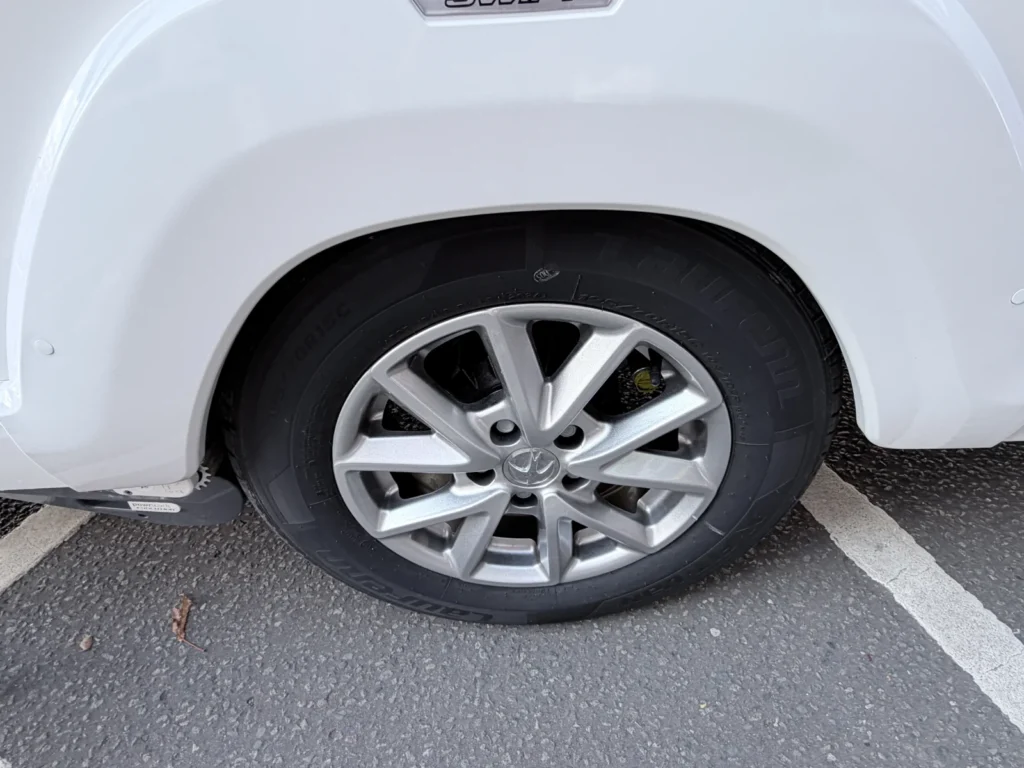

Caravan tyres rarely wear out in the same way as car tyres. They are much more likely to age out before the tread wears out.
That means a tyre can still have plenty of visible tread and no obvious punctures but still need replacing.
Good caravan tyre maintenance is therefore about much more than checking tread depth. Age, pressure, loading, storage and sidewall condition all matter.
A tyre failure while towing can be serious, but regular checks can reduce the risk significantly.
This guide explains why caravan tyres need different care, how to read the sidewall, what pressure to use and when replacement should be considered.
Why are caravan tyres different from car tyres?
Caravan tyres tend to cover low mileages while carrying relatively high loads and spending long periods stationary.
A car might travel thousands of miles each year. Its tyres gradually wear down through regular driving, steering and braking.
A caravan can behave very differently.
Some touring caravans only cover a modest number of miles each season. This means the tread may still look excellent after several years.
However, the rubber continues ageing even while the caravan is standing.
Caravan tyres also spend long periods supporting the caravan on exactly the same section of rubber.
This can happen for several months during winter storage.
Other factors include:
- Long periods exposed to sunlight
- Exposure to changing temperatures
- Atmospheric and ozone ageing
- High loads relative to tyre capacity
- Long periods without movement
- Kerb or pothole impacts while towing
The Caravan and Motorhome Club notes that caravan tyres can deteriorate through age, exposure and lengthy periods without use.
This is why checking tread alone is not enough.
Age, pressure and storage conditions often matter more for caravan tyres than they do for a car used every day.
How do you read a caravan tyre sidewall?
The tyre sidewall tells you its size, construction, load capability, speed rating and manufacturing date.
You do not need to memorise every marking.
However, understanding the main ones makes checking replacements much easier.
Imagine a tyre marked:
195/70 R15C 104/102 R
This is only an example. It is not a specification for your caravan.
Tyre width
The first number indicates the nominal tyre width in millimetres.
In our example, that is 195.
Aspect ratio
The next number describes the height of the tyre sidewall as a percentage of its width.
In this example, that is 70.
You do not need to calculate this yourself when buying replacements. Match the approved specification instead.
Construction
The R means the tyre uses radial construction.
Radial tyres are the normal construction used on modern cars, caravans and many commercial vehicles.
Rim diameter
The next number gives the wheel rim diameter in inches.
In our example, that would be 15 inches.
What does the C marking mean?
A C after the size indicates a light-commercial tyre.
These tyres have a reinforced construction designed for higher loads than a conventional passenger-car tyre.
Some caravans use commercial-grade tyres because of their load requirements.
Do not assume every caravan needs a C-marked tyre. Follow the caravan manufacturer’s approved specification.
You may also see CP markings when researching leisure-vehicle tyres.
CP tyres are designed specifically around the demands of certain motorhomes. They are not simply a special type of touring-caravan tyre.
Load index
The number after the size is the tyre’s load index.
It represents how much load the tyre is designed to carry under specified conditions.
This matters greatly on a caravan.
The replacement tyre’s load capability must meet the requirements of the caravan and its axle.
Never choose a tyre simply because the physical dimensions appear to match.
Speed rating
The letter after the load index is the speed symbol.
This tells you the tyre’s rated speed capability under specified conditions.
It does not change the legal towing speed limit.
Manufacturing date
Look for the four-digit manufacturing date code.
The first two numbers indicate the week. The final two indicate the year.
For example:
2424
means the tyre was manufactured during week 24 of 2024.
Always check the actual date code rather than relying on when you bought the tyre.
A tyre can spend time in distribution or stock before being fitted.
Most importantly, match replacement tyres to the caravan manufacturer’s specification rather than buying whatever happens to share the same diameter.
What pressure should caravan tyres be?
Set caravan tyre pressure using the manufacturer’s specification for your caravan and load.
Do not simply use the maximum pressure written on the tyre sidewall.
The figures moulded into some sidewalls describe limits or technical specifications. They are not necessarily the correct operating pressure for your caravan.
The Caravan and Motorhome Club gives an example where a commercial tyre capable of operating at 54psi at maximum load might only require 30psi in a particular caravan application.
Find the recommended pressure in:
- Your caravan handbook
- The manufacturer’s data
- A pressure plate fitted to the caravan
If you are uncertain, ask your caravan dealer or a qualified tyre specialist.
Check pressures when the tyres are cold.
Do this before towing rather than after a long motorway journey.
TyreSafe recommends checking caravan pressures before every journey and when the tyres are cold.
Remember to check the spare tyre too.
It can lose pressure while sitting unused and may be completely forgotten until you actually need it.
Under-inflation deserves particular attention.
An under-inflated tyre flexes more as it travels. This creates excessive heat within the tyre and increases the risk of sudden failure.
Pressure is therefore not just an efficiency issue.
On a caravan, it is an important part of preventing tyre failure. Tyre condition matters even more in poor weather, as our guide to winter caravanning in the UK explains.
How long do caravan tyres last?
Caravan tyre replacement should be based on age and condition, not tread depth alone.
Rubber changes as it gets older.
Exposure to sunlight, weather and long periods standing can contribute to deterioration even when the tyre covers very few miles.
You may notice:
- Fine sidewall cracking
- Cracks between tread blocks
- Discolouration
- Bulges
- Distortion
- Changes in the rubber surface
However, a tyre does not have to look obviously damaged to be old.
That is why checking the four-digit date code matters.
The Caravan and Motorhome Club recommends replacing caravan tyres when they reach five years old and says they should never remain in use beyond seven years old.
Treat this as industry guidance rather than a universal legal expiry date.
TyreSafe points out that there is no single chronological age at which every tyre becomes unsuitable. Tyre construction, use, storage and manufacturer recommendations all matter. It advises following the relevant vehicle and tyre manufacturer instructions.
So use five years as a useful point for taking age very seriously, not as a substitute for inspection.
If your caravan or tyre manufacturer gives more specific requirements, follow those.
Also remember that age begins when the tyre is manufactured, not when it is fitted.
How should you look after caravan tyres in storage?
Keep caravan tyres correctly inflated, protected where practical and inspect them before returning to the road.
Long periods without movement can place constant pressure on one section of each tyre.
This can contribute to temporary or longer-lasting flat spotting.
Where your storage arrangement allows it, moving the caravan periodically changes the part of the tyre taking the load.
Keep the tyres correctly inflated during storage too.
Allowing them to become significantly under-inflated increases deformation while the caravan is standing.
Wheel covers can reduce direct UV exposure when a caravan remains outside.
If you choose to lift the caravan for longer-term storage, use suitable axle stands and follow the caravan manufacturer’s instructions.
Support the caravan only at approved locations.
Never use the corner steadies to carry the caravan’s weight.
They stabilise the caravan rather than acting as jacks or axle stands.
There is varying advice about whether a caravan handbrake should remain applied during extended storage.
Rather than following a blanket rule, use the instructions for your particular chassis and caravan.
Before your first journey after storage:
- Check tyre pressures
- Inspect all visible sidewalls
- Check the tyre dates
- Examine the tread
- Check the spare
- Look for deformation
- Check wheel condition
Do these checks before the day you intend to travel. Our autumn caravan checklist covers the wider pre-trip inspection.
For the rest of the end-of-season process, see our complete caravan winter storage checklist.
When should you replace caravan tyres?
Replace a caravan tyre when its age, condition, damage or tread makes it unsuitable for continued safe use.
Do not wait for the tread to wear down if another problem appears first.
The legal minimum for tyres on light trailers in the UK is 1.6mm across the central three-quarters of the tread and around the entire circumference.
Caravan tyres often need replacement long before reaching this limit.
Arrange professional advice if you find:
- Sidewall cracking
- Cuts
- Bulges
- Exposed cords
- Significant kerb damage
- Abnormal deformation
- Uneven tread wear
- Repeated loss of pressure
Uneven wear deserves investigation.
Simply replacing the tyre may not address the cause. Alignment, loading or axle problems could be contributing.
A significant pothole or kerb impact should also prompt a proper inspection.
Internal tyre damage may not always be visible from the outside.
If one tyre needs replacement because of age, inspect the other tyre on the same axle carefully too.
On many caravans, both tyres were fitted at the same time and have experienced similar conditions.
Ask a qualified tyre specialist whether replacing both together is appropriate for your caravan.
Tyres are one of the recurring ownership costs covered in our guide to what it costs to own a caravan or motorhome.
Always use a fitter familiar with caravan tyre specifications, load requirements and inflation pressures.
Do not assume a standard car tyre of the same physical size is automatically suitable.
Are caravan tyres checked during a service?
Yes, tyre condition forms part of Couplands’ full caravan servicing checks.
Couplands currently lists tyres alongside brakes, chassis and road lights within its annual servicing inspection. Service centres operate at both Louth and Worksop.
A workshop inspection also gives technicians the opportunity to examine areas that are harder to see on your driveway.
These can include:
- Inner sidewalls
- Abnormal wear patterns
- Wheel condition
- Tyre age
- The spare tyre
- The spare-wheel carrier
A service is an inspection rather than automatic authorisation to replace parts.
If technicians identify an issue, they can explain what they have found and what action is recommended.
Annual checks also make it easier to keep track of tyre age.
It is surprisingly easy to forget whether a set was fitted three, five or seven years ago.
You can also read our beginner’s guide to caravan and motorhome servicing for a wider explanation of what an annual service covers.
Unsure about your caravan tyres?
If you are uncertain about your tyre age, pressure or condition, get them checked before towing.
Couplands’ workshop teams can inspect the tyres as part of a full caravan service, including areas that are difficult to see during a driveway check.
Couplands Louth
Tattershall Way, Fairfield Industrial Estate, Louth, LN11 0YZ
01507 603496
Couplands Worksop
Gateford Road, Worksop, S81 7AT
01909 475220
Contact the Couplands team to book a service before your next trip if you have concerns.
Frequently Asked Questions
How often should you replace caravan tyres?
The Caravan and Motorhome Club recommends replacing caravan tyres at five years old and never using them beyond seven years. This is guidance rather than a universal legal expiry date. Always follow your caravan and tyre manufacturer’s instructions and replace damaged tyres sooner.
How do you check the age of a caravan tyre?
Find the four-digit manufacturing date code on the tyre sidewall. The first two digits show the manufacturing week and the final two show the year. For example, 2424 means the tyre was made during week 24 of 2024.
What pressure should caravan tyres be?
Use the pressure specified by the caravan manufacturer for the tyre and load. Check the handbook or caravan pressure plate and measure pressures when the tyres are cold. Do not simply inflate to the maximum figure shown on the tyre sidewall.
Do caravan tyres need to be a special type?
The tyres must meet the size, construction and load requirements specified for your caravan. Some caravans use commercial-grade C-marked tyres, while others may have different approved specifications. Always follow the caravan manufacturer’s requirements.
Can you use car tyres on a caravan?
Only use a passenger-car tyre if it meets the caravan manufacturer’s approved specification. Physical size alone does not make a tyre suitable. Load capacity, construction and other requirements must also match, so seek professional advice when changing tyre type.
Should you take a caravan off its wheels in storage?
You do not have to lift every caravan off its wheels during winter storage. If you choose to use axle stands, follow the caravan or chassis manufacturer’s instructions and use the correct support points. Never use the corner steadies to support the caravan’s weight.